

Professor El-Shboul Participates in Launch of Andalusian Association
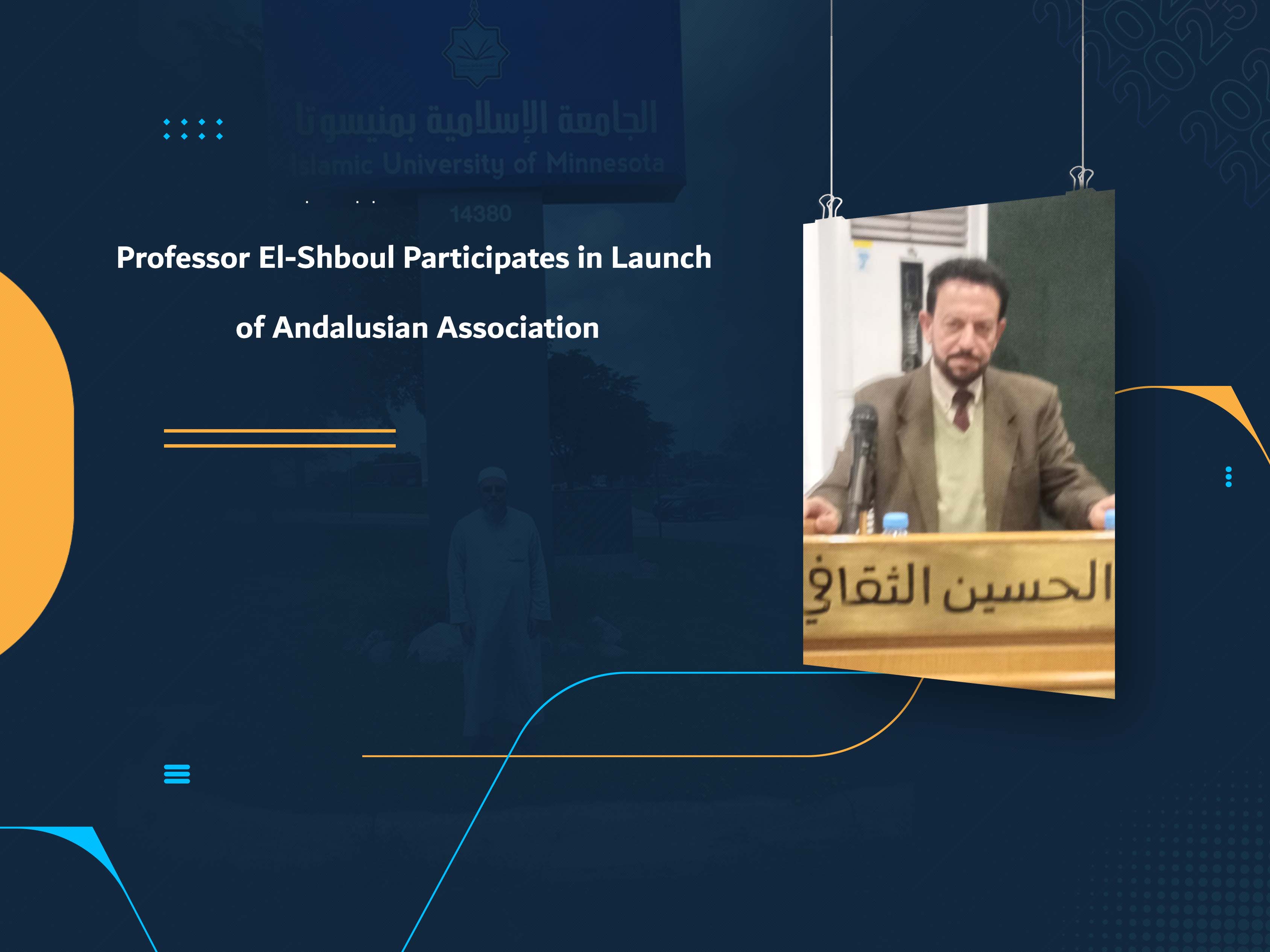
Head of Departments and Centers at the Islamic University of Minnesota Participates in Launch of First Jordanian Andalusian Studies Association and Delivers Lecture on the Influence of Arabic in European Languages
Dr. Ali El-Shboul, Head of the Department of Arabic for Non-Native Speakers and Director of both the Center for Latin American Studies and the Center for Languages and Translation at the Islamic University of Minnesota, participated in the inauguration ceremony of the "Cultural Association for Andalusian Studies" on the evening of Saturday, December 20, 2025. He attended by kind invitation and under the patronage of the Jordanian Minister of Culture, at the National Library in the Jordanian capital, Amman.
Dr. El-Shboul's participation stemmed from his ongoing academic interest in issues of civilizational interaction and cross-regional cultural studies. The event witnessed a significant official, academic, and cultural presence, bringing together an elite group of researchers, thinkers, and those interested in historical and heritage studies. The ceremony emphasized the importance of establishing the association as a scientific and cultural platform concerned with Andalusian studies, seeking to promote research on the history, literature, and arts of Al-Andalus, and highlighting its lasting civilizational impact on Arab and Islamic culture. The launch of the association is considered a qualitative addition to the Jordanian cultural scene.
Earlier, on Monday, December 15, 2025, Dr. El-Shboul participated in a scientific and cultural event celebrating World Arabic Language Day. The event was held at the King Hussein Cultural Center in Amman, upon invitation from the Cultural Working Group for Arab Cities and in cooperation with the Greater Amman Municipality. During the event, Dr. El-Shboul presented a scientific paper titled "The Presence of Arabic between Past and Present in European Languages: The Spanish Language as a Model." The presentation explored the historical and scientific dimensions of the Arabic language's influence on European languages, focusing on Spanish as a prominent model of civilizational and linguistic interaction. It highlighted Arabic's contribution to enriching the lexical and cognitive structures of European languages and its role in transmitting sciences and knowledge during pivotal historical periods, reflecting its ongoing global standing.
Dr. Nadia Abu Awda from the Department of Arabic for Non-Native Speakers also participated in managing the event's program, contributing to its smooth and organized execution, befitting the occasion's status and its cultural goals. The celebration featured a comprehensive cultural program, including official speeches, intellectual discussions, and literary segments, all collectively emphasizing the importance of the Arabic language as a cornerstone of cultural and human identity, and as a language of science and thought capable of keeping pace with the times and engaging with other cultures.